🏛️ History🔍 Investigation🏺 Mythology🧠 Psychology🤔 Philosophy

Learn and understand history, philosophy and psychology by solving interactive investigations with figures from the past

Question them in writing or out loud. Every answer draws on the teacher's documents and shows its source, so students learn to check what the AI says.

🆓 Free⚡ Ready in 2 minutes🎒 Students · Teachers · Curious minds📝 Exam revision
Parlova 2D map — a medieval French village with historical characters, their roles displayedFrance, 1356
📎 An AI that answers from your documents

Your documents, their answers, and the proof under every reply

A character who makes up facts has no place in a classroom. On Parlova, you provide the documents and facts, the AI looks up the right passage for every question, and students see where each piece of information comes from.

  1. 1

    Add your documents and facts

    PDF, Word, textbook extract, primary source: upload them when you create the mission or later in the editor. Also give each character dated facts with the source of your choice (book, archive, museum, your own lesson) or start from their Wikipedia sheet.

  2. 2

    The AI finds the right passage (RAG)

    For every student question, Parlova retrieves the passages of your documents that answer it and passes them to the character. You decide whether it may also use its general knowledge: Restricted, Semi-restricted or Open mode.

  3. 3

    Every answer shows its evidence

    Under the answer, students open the facts used, dated and sourced, and the exact extract from the document, with the quoted sentence highlighted. They learn to check what the AI says instead of taking it on trust.
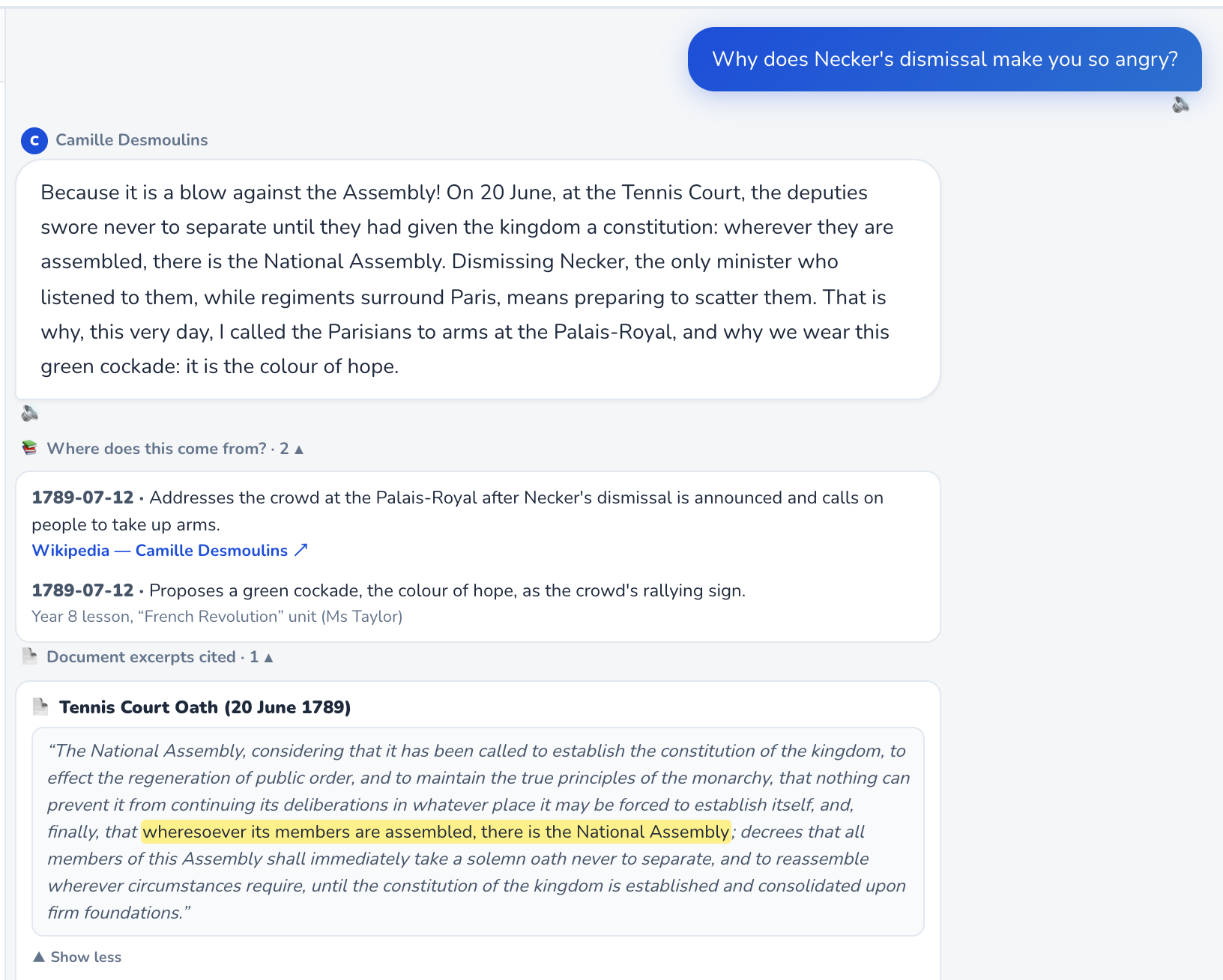
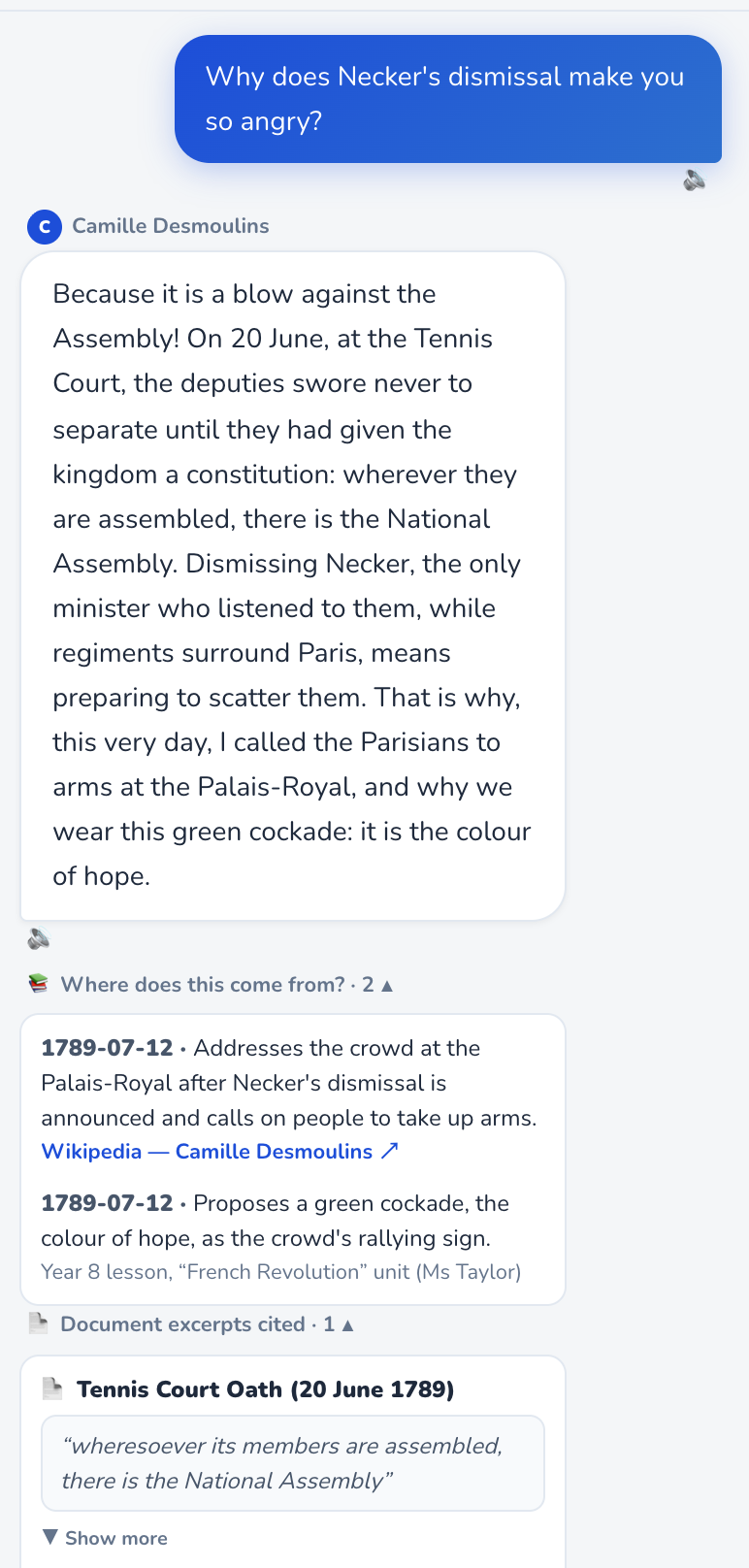
Camille Desmoulins's answer with the fact from his sheet and the highlighted quote from the Tennis Court Oath
On 12 July 1789, Camille Desmoulins answers by citing two facts from his sheet (one from Wikipedia, the other from the teacher's lesson) and the Tennis Court Oath provided by the teacher. Click to enlarge.

On the teacher's side: you stay in control
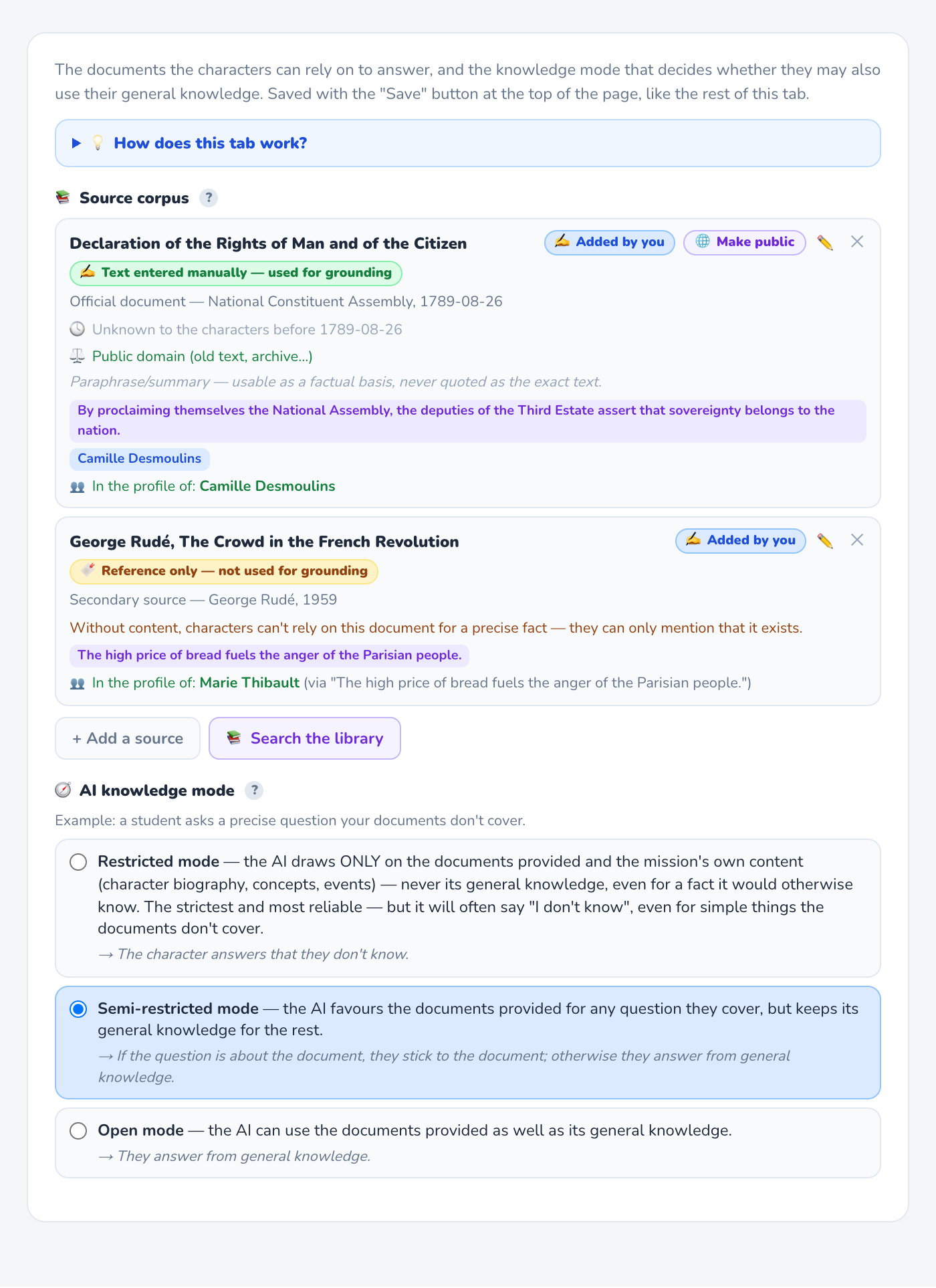
Sources tab of the editor with two documents and the knowledge mode
The mission's corpus: approved texts, “known from” date, related concepts and characters, knowledge mode.
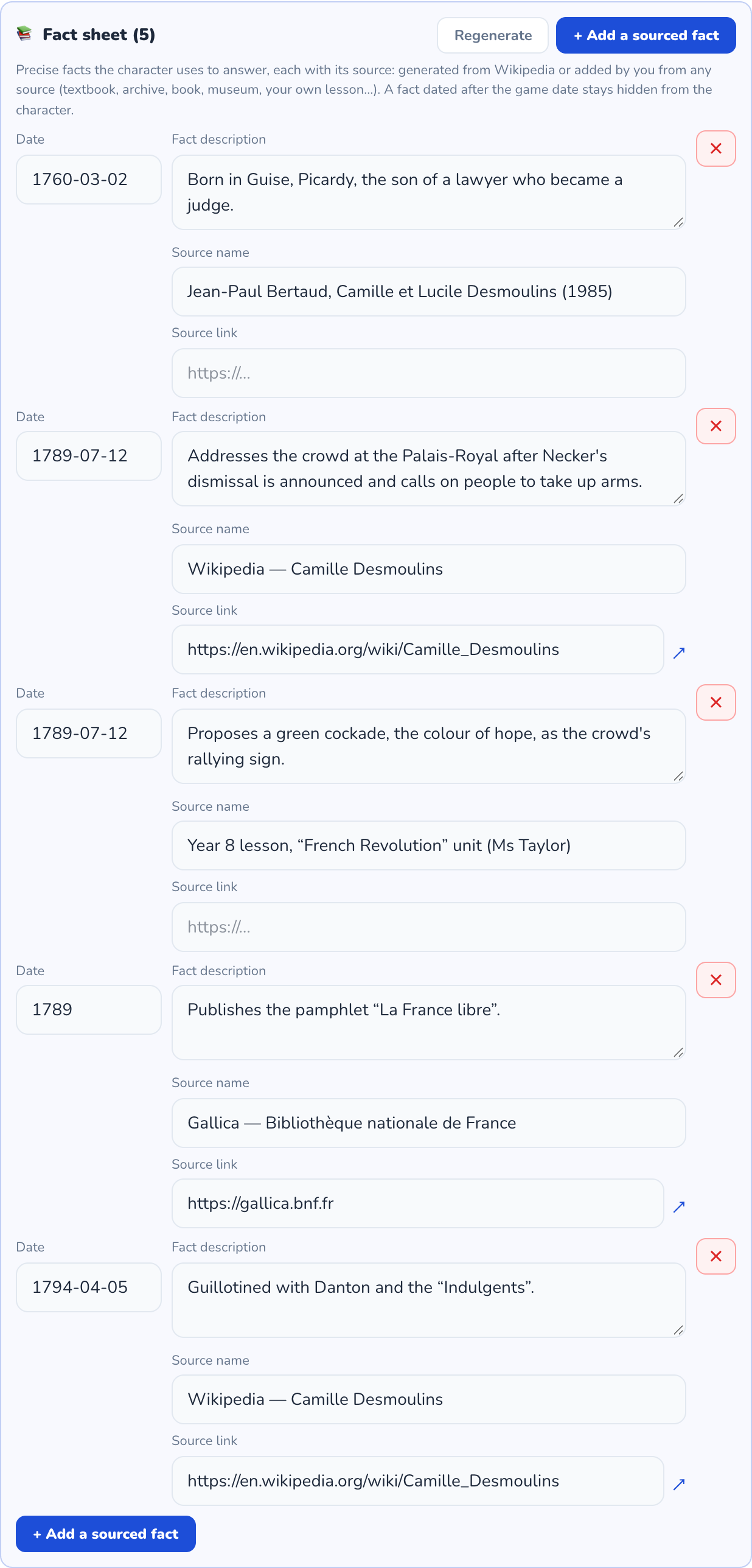
A character's fact sheet with facts sourced from a book, a lesson, Gallica and Wikipedia
A character's fact sheet: each fact has its date and its source, whatever it is (book, lesson, digitised archive, Wikipedia), and can be edited by hand.

Your documents

Add a PDF, a Word file, a textbook extract or a primary source to the mission (up to 15 MB). The character draws on it to answer, and nothing is used until you have reviewed and approved the extracted text.

A closed mode

In Restricted mode, the character only draws on your documents and the mission's own content, never on its general knowledge. If the answer is not there, it says it does not know. Two looser modes exist: Semi-restricted and Open.

A sourced sheet for each character

Every character has a sheet of dated facts, each with its source: a book, an archive, your lesson, a Wikipedia article… You add, correct or delete each fact. A fictional character never gets invented facts, and a fact dated after the time of the game stays hidden from them.

Students see the source

Under each answer, students can open the exact extract from the document provided, or the list of facts used with their sources. They learn to check what the AI says instead of taking it on trust.

Step by step: adding documents and facts →How the document corpus works →
🎯 Ready-to-use missions

Aligned with official curricula

Each mission matches a level, a subject, a curriculum objective.

Missions by level and subject

Ready to use in class, matched to the official curriculum.

Grade 6History-Geography
Why are the Greek gods so powerful?
👤 Zeus · Hermes
Greek mythology
What was life like in 5th-century Athens?
👤 Socrates
Ancient Greece
Grade 7History-Geography
Who betrayed Julius Caesar?
👤 Julius Caesar · Brutus
Ancient Rome
Why did Charlemagne unite Europe?
👤 Charlemagne
Middle Ages
Grades 8–9History-Geography · Exam prep
What caused the Revolution?
👤 Robespierre · Louis XVI
French Revolution
Was Napoleon a tyrant or a genius?
👤 Napoleon
First Empire
High schoolPhilosophy · Final exam
Can Freud explain our behaviour?
👤 Sigmund Freud
Psychoanalysis
Was Socrates right to die for his ideas?
👤 Socrates
Ancient philosophy

In line with French education guidelines, students in grades 6 and 7 (ages 11–12) do not use generative AI themselves: Parlova is used with the whole class, with the teacher leading the dialogue on the board. Students use it themselves from grade 8 (age 13–14).

See all teaching resources →
🌍 12 official curricula

Your country's curriculum, year by year

Parlova covers the official history and geography curricula of 12 countries and regions. Pick your country, the year and the chapter: the mission is ready, with its characters, key concepts and guiding question.

  • France
  • Ontario (Canada)
  • Québec
  • England (UK)
  • Spain
  • United States (AP)
  • Belgium (French-speaking)
  • French-speaking Switzerland
  • Mexico
  • Argentina
  • Chile
  • Colombia
▶ Live demonstration

Every answer
unlocks something.

📚The source of every piece of information, under the answer
🔑A historical concept you discovered yourself
🔓A secret only accessible by asking the right question
⚡XP points marking your progress
⚔️
Julius Caesar
Rome · 45 BC
🔴 Mission active

Progress is visible. And real.

Not just a chatbot — a discovery system.

🔓
Secret discovered
Only accessible by asking the right questions to the right character.
🏆
Badge earned
Rewards for every milestone reached in a mission.
🎉
Concept unlocked
The big ideas of an era revealed as the investigation unfolds.
⚠️
Contradiction detected
Did a character lie? You spotted it thanks to an inconsistency.
📜
New clue
A document, a date, a detail that changes everything about the case.
⚡
+15 XP
Points earned with every discovery — progress you can see.
🎒 Why students get hooked

They don't study.
They investigate.

✓They ask their own questions — not the textbook's
✓They discover concepts on their own
✓They unlock secrets hidden in every conversation
✓They progress through missions, with visible rewards
✓They learn by investigating, not by reading
Julius Caesar doesn't know yet that Brutus will betray him.
Napoleon knows nothing of Waterloo.
It's up to you to ask the right questions.
🎒
"It's the first time I wanted to stay after the bell."
8th-grade student — session on the Roman Republic
🚀 Launched in June 2026

Be among the first.

Parlova is brand new. Early users are shaping the product — your feedback helps us improve every mission, every character, every feature.

🆓
Free access
Every feature
🎯
Direct influence
Your feedback shapes the product
⚡
Missions in progress
New content every week
Follow us:Instagram@parlova.frTikTok@parlova.frYouTube@parlovafr
👩‍🏫 Teacher space

Built for the classroom.

While your students investigate, you watch everything in real time.

Grade 6Grade 7Grade 8Grade 9Grade 10Grade 11Grade 12
History-GeographyFrenchPhilosophyCivicsLiterature
📝 Middle-school exam prep🎓 High-school final exam prep
👁️
Real-time tracking
Which characters they're questioning, which secrets they've found, how far along they are.
📊
Concepts discovered
Individual and class-wide view — who understood what, what's left to unlock.
🎛️
Session control
Launch, pause, send a live message. All from your dashboard.
🛠️
Custom missions
Create your own investigation in minutes — characters, objectives, questions.
📄
🆕 New
Your documents as a source
Add a PDF, a course, or a textbook excerpt: the character relies on it to answer, and the student sees the exact passage cited.
🎚️
🆕 New
3 reliability levels
Free, semi-restricted or restricted: you decide whether the AI keeps its general knowledge or sticks strictly to your documents.
📝
🆕 New
Printable student worksheets
A blank sheet to fill in during the investigation — never the answers — separate from the answer key reserved for the teacher.
🎯
🆕 New
Justified score, not guessed
The student's final answer is no longer graded blindly: each expected concept is marked understood or not, with the exact sentence that proves it.
📋
🆕 New
Automatic class report
After a mission, see which concepts the class has mastered and the named list of students who haven't yet — ready to reuse in class.
🟢 Session in progress — 4 active students
Alice M.
💬 Caesar
72% discovered
Thomas B.
🔍 Leroux
45% discovered
Léa D.
⏸ Paused
88% discovered
Hugo R.
💬 Freud
31% discovered
👩‍🏫 Teacher space →🎓 Teaching resources →
🗺️ 2D map

The game unfolds on a living map

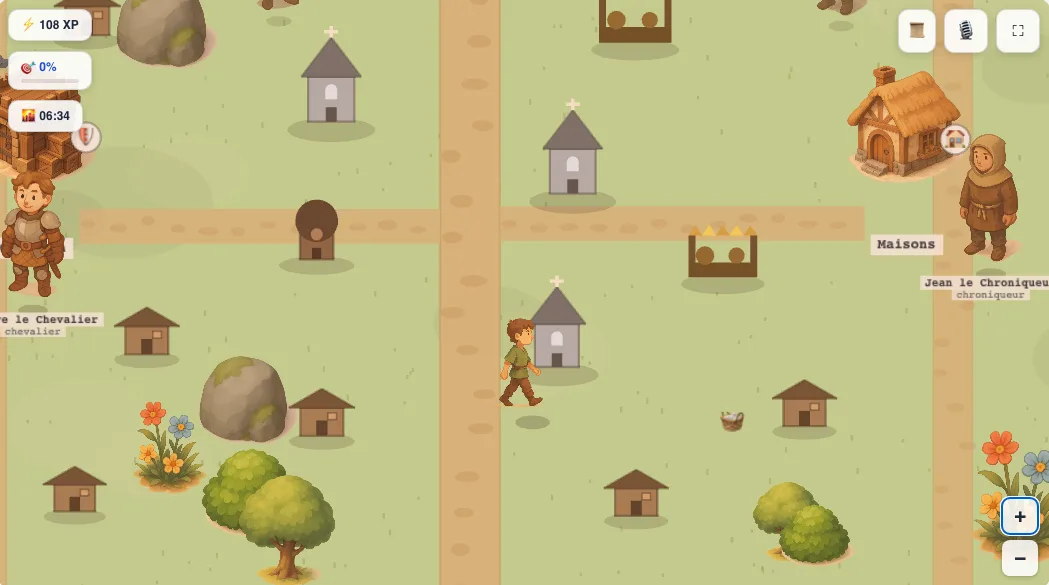
You move freely through an animated village, day and night, and meet each character — their role shown above their head.
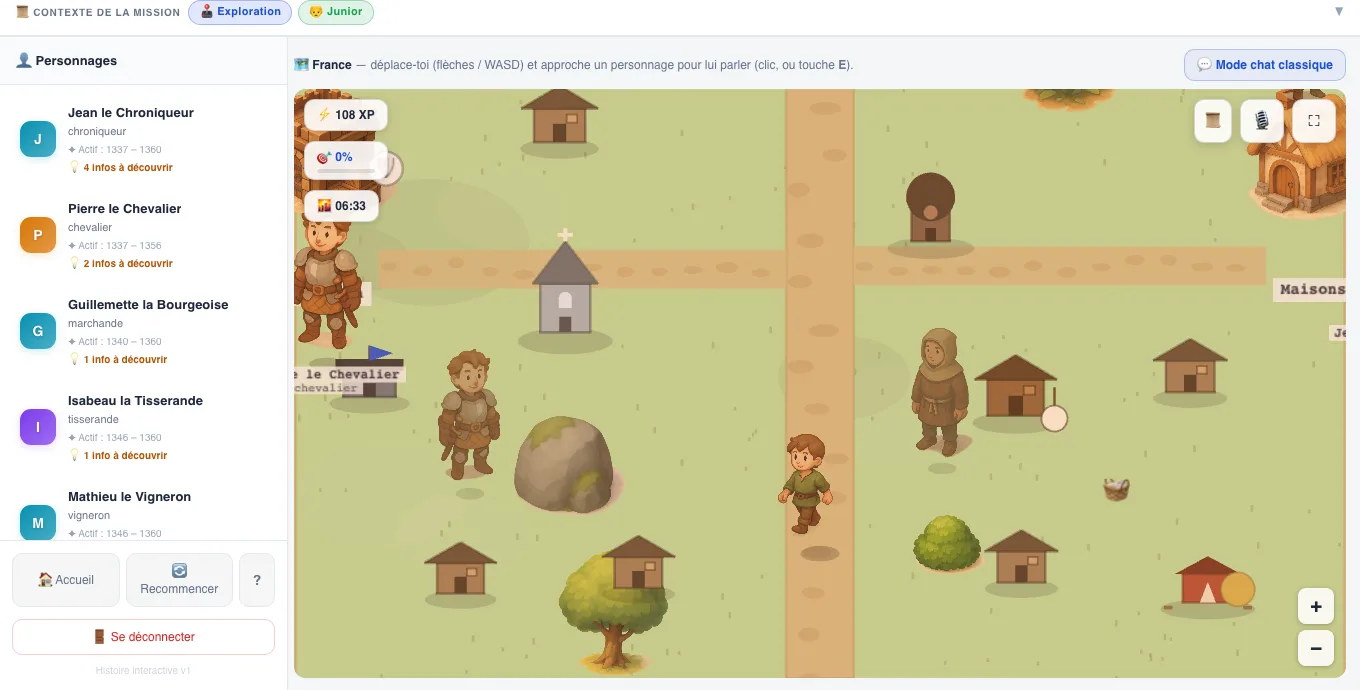
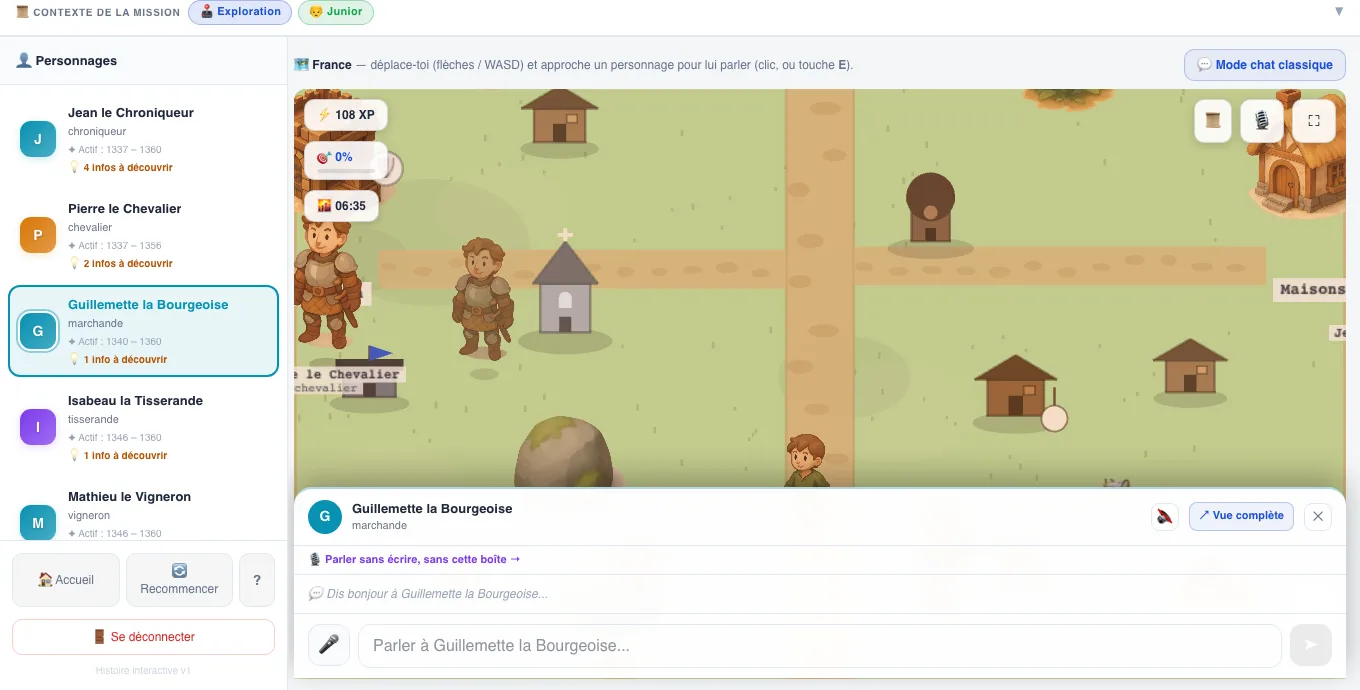
Parlova's interactive map with historical characters, their roles displayed and a day/night badge
A village to explore — each character shows their role, moves around, and the sky darkens at night.
Dialogue with a historical character opened directly on the map, in writing or by voice
Approach a character to talk — in writing or by voice, without ever leaving the map.

Every subject. Every era.

Teachers create their own missions in minutes.

🏛️The fall of the Roman Republic
🚢The exploration of the Americas
🗼Paris during the French Revolution
⚔️The Hundred Years' War
🎨The Italian Renaissance
⚗️The Scientific Revolution
🛋️Freud's case of Anna O.
🧩Jung's theory of archetypes
💭The unconscious and dreams
⚡Olympus and the Greek gods
🌊Poseidon and the mysteries of the sea
🌙The Norse gods and Ragnarök
🐍Osiris, Isis and death in Egypt
🔍Locked-room murder
🕵️Disappearance in Paris, 1920
⚖️The lying witness
🗡️Impossible alibi — who's lying?
🌍African decolonisation
🔭Galileo before the Inquisition
⚖️The trial of Socrates
🤔Is freedom an illusion?
🪞Can we know ourselves?
✨And anything you can imagine…

Explore by domain

🏛️
History
Caesar, Napoleon, Marie Curie…
🧠
Psychology
Freud, Jung, clinical cases…
🏺
Mythology
Zeus, Hermes, Osiris…
🔍
Investigation
Witnesses, clues, contradictions…
🤔
Philosophy
Socrates, freedom, truth…

Frequently asked questions

🔍

Ready to lead your first investigation?

Free. No install. In under 2 minutes, you can question Julius Caesar.

Parlova·Terms of use·Privacy policy·Legal notice·Contact